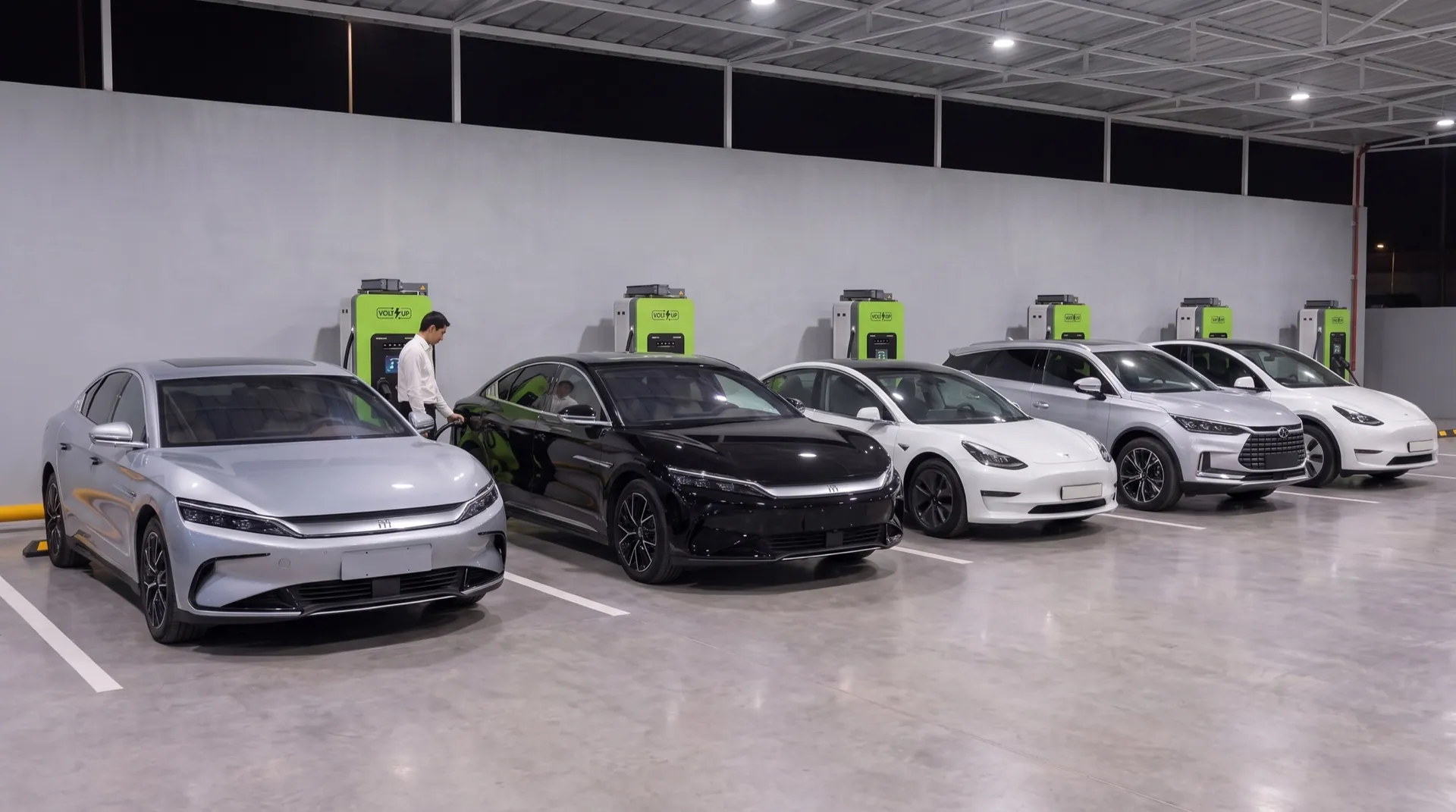

The basics

What DC fast charging is
DC (direct current) fast chargers deliver power suited to topping up quickly between jobs. That is different from slower AC charging often used overnight at home or the workplace.
Built for shorter stops
Useful when drivers need meaningful range in a limited window — between shifts, between bookings or before the next run.
Charger rating ≠ car power
The kW figure on a charger is its maximum rating. Your vehicle decides how much of that power it can take at any moment.
Connector still matters
At VoltUp, published public ports are CCS2. Confirm your inlet before you travel — see EV Compatibility if you are unsure.
At VoltUp today
VoltUp’s published charger power
Public equipment at the current operational station is fixed DC hardware. We publish the charger rating only — not a guarantee of the power your vehicle will draw.
Published charger rating
120kW DC
4 fixed 120 kW DC chargers at Umm Ramool. Actual session power varies by vehicle, battery state, temperature and site conditions.
- 4Fixed DC chargers
- 8CCS2 ports
- 8Covered bays
- 24/7Listed hours
Charger ratings
What 120, 160, 180 and 240 kW mean
These numbers describe a charger’s maximum rated power. They are not a promise of how fast every car will charge, and they are not a claim that VoltUp operates every level listed here.
120 kW
VoltUp today
The published rating on VoltUp’s fixed DC chargers at Umm Ramool. Suitable for high-use commercial and private drivers who need practical DC access.
160 kW
Higher rating class
A higher maximum on the charger. Only vehicles and conditions that can accept it will approach that figure — many sessions still run lower.
180 kW
Higher rating class
Another step up in rated capacity. Useful as a planning label for hardware class — not a per-session speed guarantee.
240 kW
Higher rating class
Among the higher DC ratings commonly discussed. Peak delivery still depends on the car’s battery management, state of charge and temperature.
Real-world sessions
Why a car may charge below the charger’s maximum
Seeing less than 120 kW (or any posted rating) is normal. The charger sets a ceiling; the vehicle and conditions set the session.
Battery state of charge
Many EVs taper power as the battery fills. A nearly full pack will often accept far less than the charger rating.
Temperature and conditioning
Hot or cold packs, and whether the car has pre-conditioned the battery, change how much power the vehicle will accept.
Vehicle hardware limits
Onboard charging limits, cable and inlet design, and the car’s software all cap session power — regardless of the charger label.
Site conditions
Shared infrastructure, maintenance modes and temporary faults can reduce available power. Hours open does not mean every bay is free or at full rating.
Who it helps
Why fast charging matters for high-mileage driving
DC access supports drivers who cannot wait on slow AC between jobs.
High-mileage drivers
Shorter, higher-power stops help keep a working day moving when range must be restored between trips.
Taxis and chauffeurs
Practical DC near the work day — covered bays and driver facilities matter as much as the rating on the charger.
Fleets
Commercial EVs need predictable places to top up, with clear power ratings and a team on site.
Where to charge
Where to use DC fast charging with VoltUp
Today VoltUp operates one public DC station in Dubai: Umm Ramool.
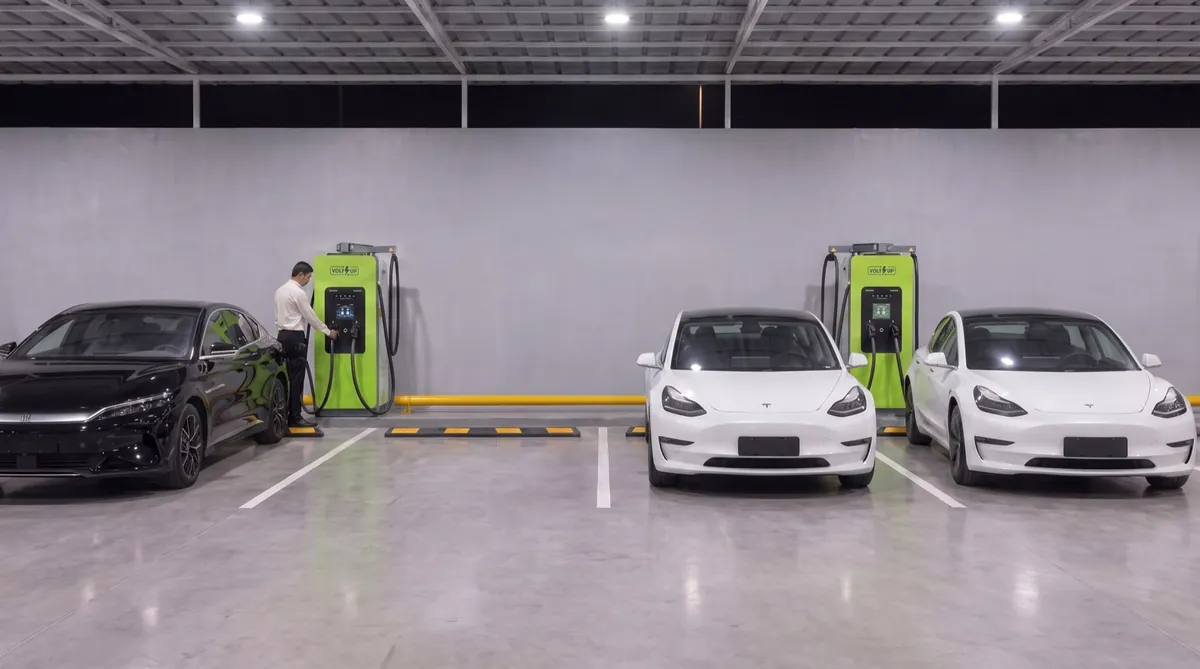 Published site
Umm Ramool, Dubai
VoltUp EV Charging Station — Umm Ramool
- 4 × 120 kW DC
- 8 CCS2 ports
- 8 covered bays
- open 24/7
Actual charging power varies by vehicle and conditions.
Ready to charge?
Go to the Umm Ramool station page
Address, hours, facilities and on-site help — without repeating this ratings guide.